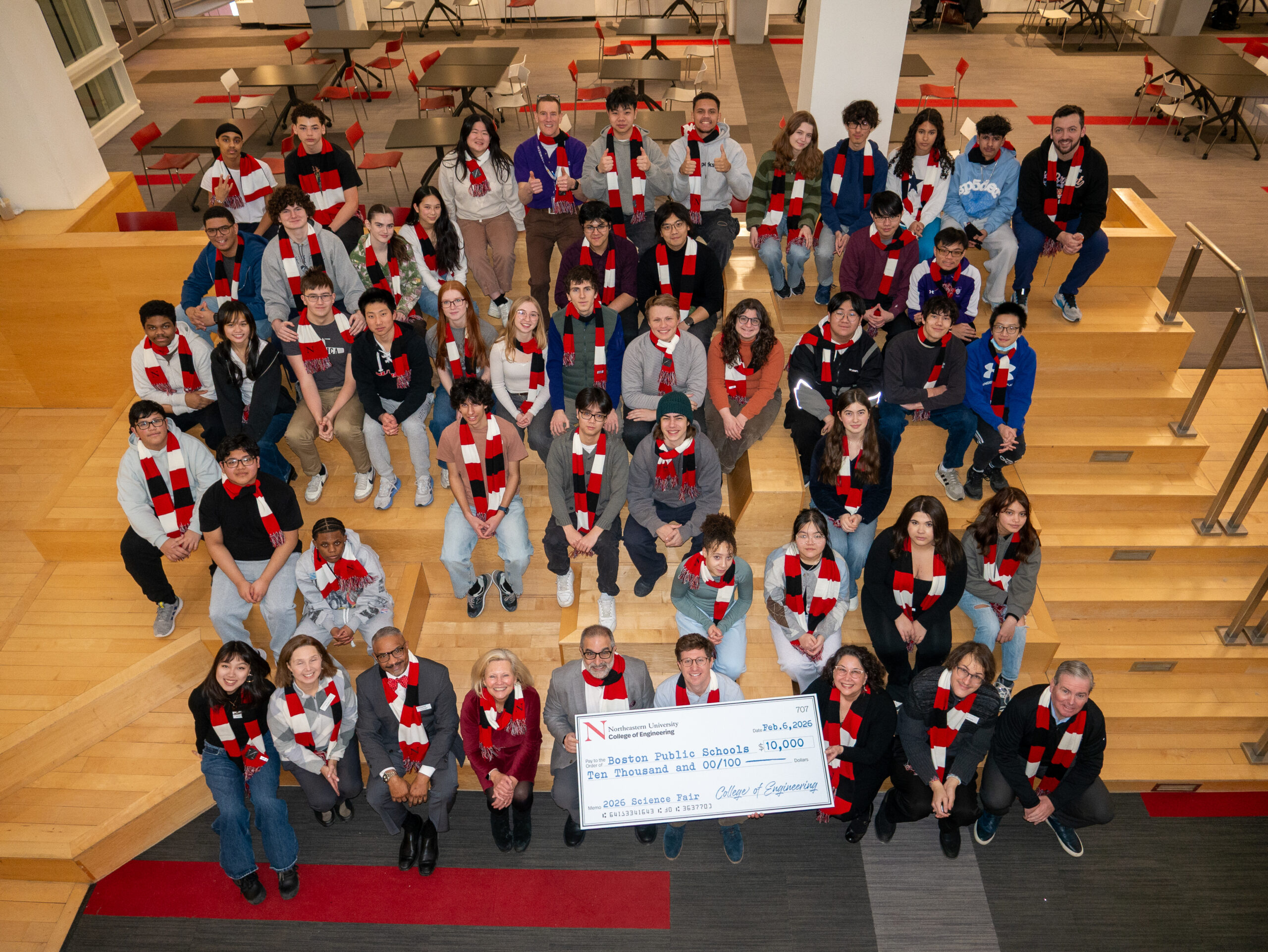
BLS and O’Bryant Schools with Northeastern’s donation to the BPS Annual STEM Fair!
On Friday, February 6th, 2026, the Michael B. Silevitch and Claire J. Duggan Center for STEM Education hosted 12th graders from Boston Latin School and 9th graders from the John O’Bryant School of Mathematics and Science for a special STEM field trip on our Boston campus to support Boston Public Schools’ STEM education initiatives.
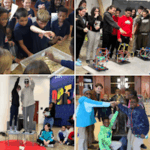
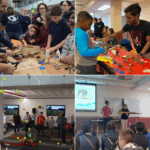
We started the day with a formal introduction by administrative staff from the College of Engineering, including Dean Gregory D. Abowd, Associate Dean of Engineering Richard Harris, and Center for STEM Education’s Executive Director Claire Duggan, as well as John Tobin, VP of NEU’s City and Community Engagement team. In a meaningful demonstration of Northeastern’s commitment to STEM education in Boston, the College of Engineering presented a $10,000 check to support the Boston Public Schools’ annual STEM Fair.

Special guests from Northeastern’s CoE & BPS STE Department
This contribution reflects the College of Engineering’s dedication to fostering scientific curiosity and innovation among BPS students across the district. The ceremony highlighted the strong established partnership between the Center for STEM Education and Boston Public Schools, emphasizing a shared mission to make STEM education accessible and engaging for all students. Dean Abowd spoke about the importance of creating pathways for young people to explore STEM fields and the role universities play in supporting public education. This field trip represents another pillar of our commitment to supporting BPS STEM – both through direct collaboration with the annual BPS STEM Fair and through our comprehensive STEM field trip offerings that bring hundreds of students to campus each year to experience hands-on engineering activities.

Designing paper towers!
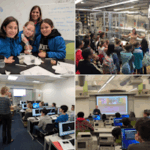
Following the ceremony, the high school students learned about engineering and the design process and launched into an engineering challenge to design and build the tallest free-standing tower out of paper. After some trial and error, some groups had towers that reached up to 70 inches tall!
After the presentation, the two schools split up and were led by our undergraduate student volunteers for the rest of the day. Students investigated heat transfer in a Sustainable Home civil engineering activity with research assistant Chris Dankwah from Professor Michael Kane’s Lab. The Kane lab is focused on understanding how people interact with their thermostats to control the heating and cooling systems in their homes to meet their comfort needs.

Insulating tiny homes!
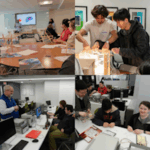
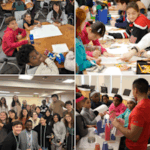
The students worked in groups to insulate and maintain heat from a light bulb inside a “Tiny Home” glass case – a real-world engineering challenge that civil and environmental engineers face when designing energy-efficient buildings! Teams used materials like Styrofoam and tinfoil to create insulation barriers, testing different configurations and thicknesses. Temperature probes measured the heat inside their glass cases, allowing students to see in real-time which insulation strategies were most effective.
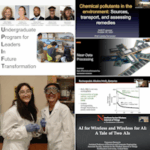
Another activity was hosted by Northeastern alumnus and civil engineering Professor Loretta Fernandez on identifying pollutants and chemicals in the environment. The students performed their very own thin layer chromatography (TLC) on known and unknown samples – the same analytical technique used by environmental engineers and chemists to identify pollutants in soil and water. They learned how TLC works as a separation technique through capillary action to create distinct bands or spots based on different chemical properties. It was exciting to see the students’ reactions when they matched their unknown chemical to one of the known pollutants. Dr. Fernandez also shared her background and career during the student Q&A.
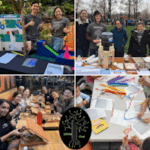
The students ended the day with lunch, asking the Northeastern student volunteers about college life and the college experience. They had many questions about how the volunteers knew engineering was the right fit for them, the college application process, balancing coursework with extracurriculars, and time management strategies for success in college. Our volunteers shared honest perspectives about their own experiences choosing majors, navigating the transition from high school to college, and what they wish they had known as high school students.

Thank you to the BLS and O’Bryant high schoolers for being great engineers!
Finally, they went on a comprehensive tour led by the Northeastern student volunteers around campus. They got to see state-of-the-art facilities like the First Year Engineering Learning and Innovation Center, where first-year students work on collaborative projects and learn foundational engineering skills. They also visited the Makerspace in EXP, where students have access to 3D printers, laser cutters, and other advanced fabrication tools to bring their design ideas to life. The tour gave students a glimpse into what college life at a research university looks like and the incredible resources available to engineering students.
We’d like to thank the Boston Latin School and the John D. O’Bryant School students for a wonderful Friday field trip!