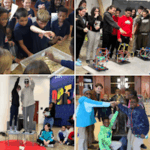
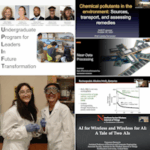
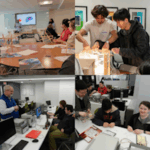
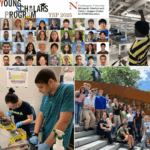
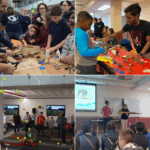
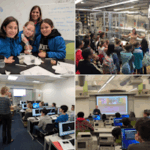
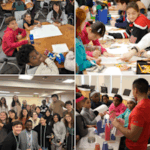
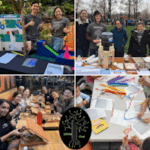
On November 7th, 2025, 38 5th and 6th graders from Chittick Elementary school came to Northeastern’s campus to learn about the ways engineers design to save energy. With no time to spare, each group was split into two sections: one sent to the civil engineering space to do the tiny homes activity, the other stayed in the student center to work on the wind turbine activities.
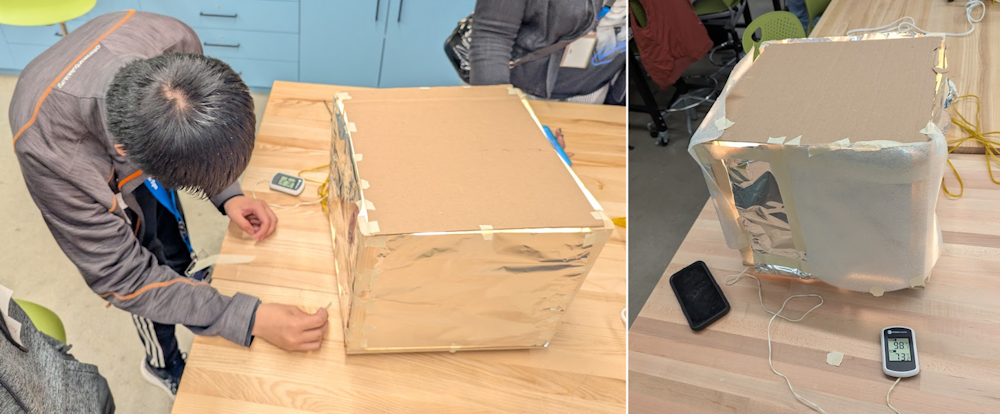
The tiny homes had students literally work with a tiny home – four walls of clear acrylic with a piece of cardboard as the roof and a table as the floor, with only an incandescent light bulb within. The student’s goal was to support their tiny home with various materials – cement blocks, insulated foam, tin foil, etc. – so that heat doesn’t escape. The catch: these materials cost money, and they had a limited budget. Some groups decided to spend all their budget at once, buying materials that they thought would trap the most heat. Others focused more on the budget, hoping to have some money left over to reiterate on their design.
For the wind turbines, students were given an introduction on how they are used to generate energy as efficiently as possible. The Center of STEM already has a wind turbine machine thanks to a previous senior mechanical engineering capstone project, so all that the students had to do was design the turbine blades. They had 3 options: choose the number of blades, choose the shape and size of the blades, and decide how far out the blades would be from the axis of rotation. These range of choices would allow the students to see how each component affects how fast the turbine blades moved, which directly correlates to how much energy it would produce.
Both activities helped students learn the engineering design process, where they found a problem, designed a prototype, tested that prototype and if they have time, improve on their design. There was also a lot of collaboration that happened, not only within each group, but between each groups. Many students gave each other hints on how to better maximize their energy efficiency, in the true spirit of engineering.
Thank you to all the volunteers that came!