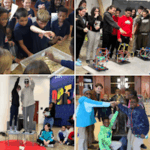
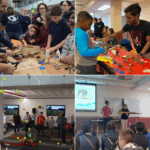
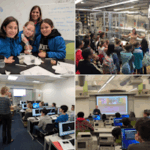
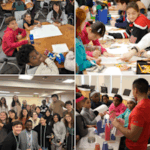
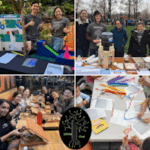
On Friday, November 21st we had our last STEM field trip of the Fall 2025 semester: this semester we had 6 field trips with a total of 311 students.
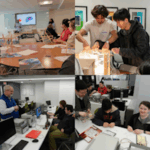
This day St. Agatha School from Milton came with 62 middle school students to learn about engineering and the design process. Northeaster’s chapter of the Society of Women Engineers (NEU SWE) also provided volunteers for today’s field trip! As the students arrived, they were thrown directly into a do-now engineering challenge in which each table worked together to build the tallest tower with 4 pieces of paper and a foot of tape and just 5 minutes. Two teams managed to make extra tall towers, but some other design’s didn’t quite work so well (remember to test your design as you go – not just at the end!.
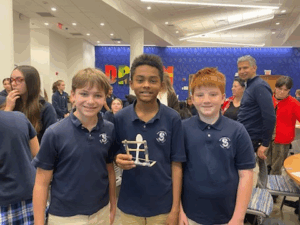
Well-designed catapult!
Students then did an activity focused on military engineering / mechanical engineering: building catapults! Students were tasked with making the most accurate (close to target) and precise (consistent) catapult -> scoring points for hitting me (Nick, the teacher) [1 for arms/legs, 3 for torso, 5 for head]. People always ask me why I’m willing to get shot at for this activity
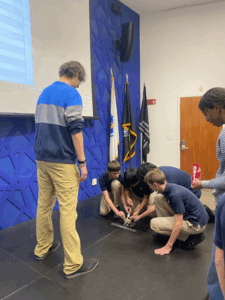
Shooting catapults at Nick
– it’s because it’s really hard to make a popsicle stick catapult that is consistently accurate. It’s honestly one of my favorite activities – and yet, most teams on average score about 1 point. The very first catapult to test though scored 13 points, which is really high – and I was worried for the rest of the tests, but this turned out to be a fluke and was the highest score over 21 teams.
We followed this up by transitioning to an aerospace engineering activity: designing paper rockets. Students worked together to build rockets that fly as high as possible, coming up with their own fin designs, nosecones, and fuselages. When we tested today, our highest rockets were going up about 100 feet – and when we shot our best rockets at 45 degrees, they flew across Centennial.
We wrapped the day up with a campus tour – during which students had a chance to ask our volunteer tour guides questions about college and campus. As part of this tour, each group visited Professor Eno Ebong‘s lab. Here they got to see a Chemical Engineering lab in action and talk to graduate students working in engineering research.