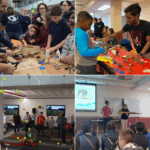
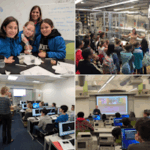
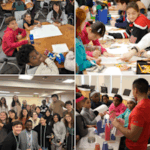
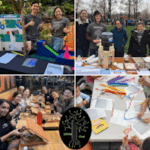
On Friday, October 17th, the Center for STEM Education had their fourth STEM Field trip of the semester, in which 69 x 6th grade students from the McKay K-8 School came to campus for a day all about Civil & Environmental Engineering and City Planning.
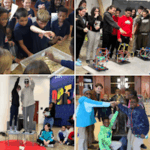
The day started off right away with a Do-Now Activity focused on building paper towers. First each individual student was given a single piece of paper and told to build a tower as tall as possible. After 10 minutes, students shared what worked and what didn’t work. The activity was repeated, this time with a partner, 2 papers, and a piece of tape (a single 5160 mailing label). Students then again had 10 minutes to use what they learned from the first build session to design and build a tower. I wasn’t very strict on rules – to see what kinds of creative designs groups would come up with (knowing full well that some groups would do something wild). And I wasn’t wrong -> multiple teams incorporated their water bottles into their designs, or the rulers, or scissors. This always reminds me of my college professor who always insisted engineering is about creativity and to push / make crazy designs (especially if the rules are vague / it’s still allowed). For his final project (virtual reality environment), the only rule was that you couldn’t collide with objects -> so I designed my environment so that when you moved, every object in the environment moved the same distance and direction -> got an A on the project!
 The final part of the Do-Now activity was to take everything learned, and to build a natural disaster proof tower. Teams were allowed to use any materials on their table (and given an extra 2-3 pieces of paper), including previous materials. They were then told to build a tower that can resist either a hurricane, a tornado, or an earthquake – they wouldn’t know which. Testing for hurricanes was done by rolling marbles at their base (representing storm surge); testing for tornado was by shooting their tower with a nerf gun (representing high winds); testing for earthquakes was done by shaking their table vigorously (representing…shaking). Like real life – you for the most part don’t know when a natural disaster will strike (moreso for tornado and earthquakes, there’s a bit more warning for hurricanes) – so their towers had to be both flexible and strong.
After this, we finally got to the introduction: first to the engineering design process, then to natural disasters. After discussing the effects of different types of disasters, groups of students were tasked to come up with both a disaster plan (how your city will prepare for the disaster before, during, and after it happens) and an emergency supply kit (for people’s homes). Each group was assigned a different disaster, and at the end we compared and contrasted between plans/kits (disasters included earthquake, hurric ane, blizzard, heatwave, extreme cold, and pandemic).
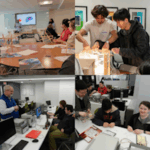
During lunch, NEU student volunteers answered questions about college (incl. Northeastern) and STEM. Questions were asked about campus life, class schedules, hobbies / extracurriculars, what students liked about Northeastern, and how to prepare for college.
We wrapped up the day with another hands-on activity: portable levees (inspired by Boston 2030’s East Boston Climate Action Plan). In this activity, students learned about Boston’s risk of coastal flooding (check out Boston’s Climate Resilience maps) and then designed and built a levee that can be put in place and taken out afterwards (such as these professional portable flood barriers). Teams then tested their designs with a flood of water and we timed how long their designs lasted (from 8 seconds to 34 seconds).
Thank you to all volunteers who helped out today. We had a few new volunteers, as well as members of ENGR 4956.